 blog
7 Signs You Need Emergency HVAC Repair Same Day Service
Last Updated: October 26, 2026
Quick Summary
Emergency HVAC repair same day service sends a trained technician to your home within hours, not days, to diagnose and fix a heating or cooling failure that threatens health, safety, or property. We treat any no-cool or no-heat call during extreme weather as urgent, because a house can become dangerous long before the next business day arrives.
- Call immediately for no cool air above 90°F, no heat during a hard freeze, or a burning plastic smell.
- A true emergency involves risk to people or property; everything else can usually wait for a scheduled visit.
- Run the five-minute troubleshooting checklist first, since roughly a third of calls resolve over the phone.
- Same-day service means a technician arrives and diagnoses the same day, not that the repair always finishes.
- Ask whether the diagnostic fee is waived if you approve the repair, and get it in writing.
Table of Contents
- When to Call for Emergency HVAC Repair Same Day Service
- How to Tell an Emergency From a Non-Urgent Repair
- Your HVAC Troubleshooting Checklist Before You Call
- What Emergency HVAC Repair Response Time Really Looks Like
- What Happens During a Same-Day Service Visit
- What Drives HVAC Repair Cost and After-Hours Pricing
- Why 24-Hour Emergency HVAC Repair Beats Waiting Until Morning
- Scheduling Your Same-Day Emergency HVAC Repair
- Frequently Asked Questions
When to Call for Emergency HVAC Repair Same Day Service
Here is the part most homeowners get wrong: they wait. They open every window, drag out a box fan, and tell themselves the unit will come back on. Sometimes it does.
The seven signs below are the ones we want you to recognize immediately. Each one points to a problem that gets worse, not better, with time.
- No cool air at all when outdoor temperatures are climbing past 90°F
- No heat during a hard freeze, especially with infants, elderly adults, or pets in the home
- Burning or melting plastic smell from vents or the unit itself
- Repeated breaker trips when the system starts
- Water pooling around the indoor unit or ceiling stains below it
- Loud banging, grinding, or screeching that started suddenly
- Carbon monoxide alarms or flu-like symptoms in the household
That last item is not a repair call. It is a safety call. According to the Environmental Protection Agency's guidance on carbon monoxide, CO is odorless and can build to dangerous levels in a closed home within hours.
If any item on that list is happening right now, call for service rather than waiting for a convenient appointment window.
How to Tell an Emergency From a Non-Urgent Repair
A true emergency involves risk to people or property; everything else is uncomfortable but can usually wait for a scheduled visit. That single distinction saves you money and keeps urgent crews available for the households that genuinely need them.
Use this triage list before you pick up the phone:
- Emergency: no heat below freezing, no cooling during a heat advisory, gas smell, CO alarm, sparking, smoke, or active water leak
- Urgent but not emergency: weak airflow, a system that runs but never satisfies the thermostat, ice on the refrigerant lines
- Can wait for a normal appointment: one room warmer than others, minor rattling, a thermostat that needs reprogramming
A common mistake is calling an after-hours line for a non-urgent issue. You will pay a premium for speed you did not need. The reverse mistake is worse: sitting on a gas smell because you do not want to bother anyone.
Best for: households with health risks, infants, or elderly residents who should call at the first sign of failure. Skip if: the system is running fine and you simply want a tune-up, which belongs on a scheduled maintenance visit.
Use this triage list to decide how fast you need a technician.
| Category | What it includes |
|---|---|
| Emergency | No heat below freezing, no cooling during heat advisory, gas smell, CO alarm |
| Emergency | Sparking, smoke, or active water leak |
| Urgent but not emergency | Weak airflow, system runs but never satisfies thermostat, ice on refrigerant lines |
| Can wait for a normal appointment | One room warmer than others, minor rattling, thermostat needs reprogramming |
Your HVAC Troubleshooting Checklist Before You Call
Run this HVAC troubleshooting checklist first. It takes five minutes, and roughly a third of the calls we receive resolve over the phone because of something simple.
- Check the thermostat: mode set to cool or heat, fan set to auto, setpoint actually below or above room temperature
- Replace or inspect the air filter; a clogged filter chokes airflow and can trip the system
- Confirm the outdoor unit has power at the disconnect switch
- Reset any tripped breaker once, and only once
- Clear debris, leaves, or snow from around the outdoor unit
- Verify the condensate drain line is not clogged or overflowing
- Note the exact symptoms and when they started
Write down what you find. A technician who knows the system tripped a breaker twice will diagnose faster than one starting from scratch.
Watch out: if you smell gas or hear sparking, stop the checklist and leave the building. No amount of troubleshooting is worth that risk.
What Emergency HVAC Repair Response Time Really Looks Like
Honest response time depends on three things: your distance from the dispatch point, the current call volume, and whether the needed parts are on the truck. A reliable provider gives you a realistic window, not a vague promise.
What we will not do is quote a number we cannot hit. During a regional heat wave, every HVAC company in the area is slammed at once. A crew that tells you "two hours, guaranteed" at 6 p.m. on the hottest day of the year is either overstaffed or overpromising.
Here is what clear communication looks like on the phone:
- A specific arrival window, not "sometime today"
- A named technician and a callback number
- A plain explanation of any after-hours charge before dispatch
- A heads-up if the window slips
If you are coming from a big-box service contract, expect a different rhythm. Those programs often route emergencies through a national call center, which adds a layer between you and the person actually coming to your door.
What Happens During a Same-Day Service Visit
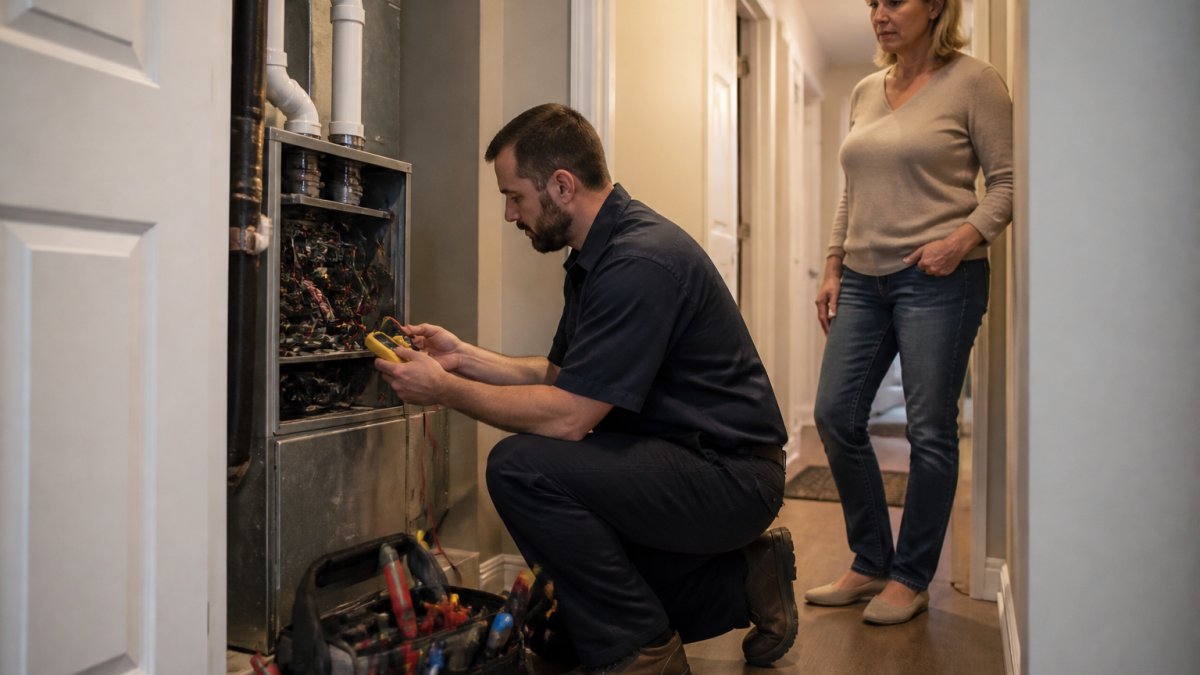
A same-day visit follows a predictable sequence: intake, diagnosis, a clear repair recommendation with pricing, and completion on the spot whenever parts allow.
**1.
2. Arrival and safety check. The technician confirms the symptoms you reported and inspects the system before touching anything.
3. System diagnosis. Expect electrical testing (capacitor, contactor, breaker, control board), refrigerant pressure checks on cooling systems, airflow measurement, and a look at the thermostat and controls.
Get Your Free Estimate →
4. Findings and approval. You get the findings in plain language, along with repair options ranked by cost and expected lifespan.
5. Parts availability. This is where same-day service most often hits a wall.
6. Completion or next step. If parts allow, the repair is completed and tested the same day.
We keep customers informed at each stage. That is not a slogan; it is how we aim to avoid the "what is taking so long" phone call.
What Drives HVAC Repair Cost and After-Hours Pricing
HVAC repair cost comes down to four variables: the part that failed, labor time, the time of day, and whether the system needs refrigerant. There is no honest flat number, because a capacitor swap and a compressor replacement live in completely different worlds. What you can do is understand the fee structure before the truck arrives, so the invoice does not surprise you.
Diagnostic fee. Most companies charge a diagnostic or trip fee to send a technician. Policies vary: some waive it if you approve the repair, others charge it regardless of whether you proceed.
After-hours and overtime charges. After-hours pricing exists because the technician is giving up their evening or weekend. A transparent provider discloses the after-hours rate before dispatch, not after the work is done.
Parts and labor. Parts pricing varies by brand and model, and labor time varies by access, a furnace in a closet is faster to service than one in a crawlspace.
Refrigerant. Refrigerant is priced by the pound and by type. A system with a slow leak may need both a recharge and a leak repair; a recharge alone is a temporary fix.
What most guides miss is the diagnostic fee question. Some companies waive it if you approve the repair; others charge it regardless. Know which one you are dealing with before the truck arrives.
Why 24-Hour Emergency HVAC Repair Beats Waiting Until Morning
Waiting until morning feels safe until you count the real risks. A home without heat in freezing weather invites frozen and burst pipes, which cause far more damage than the repair itself. A home without cooling during a heat advisory puts vulnerable residents at genuine medical risk.
The CDC's heat and health guidance is blunt about this: heat illness escalates quickly, and indoor heat can be as dangerous as outdoor heat when airflow stops. The National Weather Service's heat safety resources make the same point about timing, and both are worth reading before the next heat wave.
Then there is the equipment math. A system struggling with a small electrical issue can fail catastrophically if it keeps running. A refrigerant leak does not fix itself; it starves the compressor, and compressors are the most expensive part in the system.
Round-the-clock availability is not a convenience. It is damage control.
Scheduling Your Same-Day Emergency HVAC Repair
Calling is the fastest path: tell us the symptoms, the system type, and your address, and we will give you a real arrival window. Have your thermostat setting, filter condition, and any breaker activity ready. That information shortens the diagnosis.
Nick's Oasis LLC handles central air, ductless mini-split systems, heat pumps, and furnaces for both homes and commercial buildings. Property managers with multiple buildings can set up scheduled maintenance across a portfolio, which is how you prevent most emergencies in the first place. Our team works to catch issues before they become major problems and keeps you informed from the first call to the final walkthrough.
If the system is simply old and unreliable, ask about replacement options during the visit. One conversation beats three emergency calls.
Frequently Asked Questions
When should I call for emergency HVAC repair instead of waiting?
Call for emergency HVAC repair same day service when indoor temperatures climb above 90°F or drop below 50°F, when you smell gas or burning, when the system leaks water or refrigerant, or when a vulnerable person in the home is at risk. A furnace blowing cold air during a freeze or an AC that stops cooling during a heat wave counts as urgent. If the system is simply running a little louder or cycling oddly, a standard appointment can usually wait.
Can I get same-day HVAC repair service, and what affects response time?
Same-day service is often possible, but HVAC repair response time depends on the season, the time of day, and how many calls are already queued. Summer heat waves and winter cold snaps create the longest waits. Calling early, describing the symptoms clearly, and confirming whether the technician handles your system type all shorten the process. Ask the dispatcher for a realistic arrival window rather than a vague promise.
What should I check before calling an emergency HVAC technician?
Run through a short HVAC troubleshooting checklist first: confirm the thermostat is set to the right mode and has fresh batteries, check the air filter for heavy buildup, verify the breaker and the outdoor disconnect switch are on, and clear any ice or debris around the unit. These steps take minutes and sometimes solve the problem. If the system still fails, note the symptoms so the technician arrives prepared.
How much does emergency HVAC repair cost, and will after-hours service cost more?
HVAC repair cost depends on the failed part, system type, and whether the call falls outside normal hours. Emergency and after-hours visits often carry a higher service-call fee than daytime appointments, and parts add to that. Ask for the diagnostic fee and any after-hours surcharge before booking, and request a written estimate before work begins.
When your system fails at the worst possible moment, you need a crew that answers, shows up, and explains the repair before touching a wrench. Nick's Oasis LLC provides expert HVAC repair and installation across central air, ductless mini-splits, heat pumps, and furnaces, with clear communication from dispatch to done. Get your free estimate and get your home comfortable again.