 Ultimate guide
Are Commercial HVAC Maintenance Contracts Worth It?
Last Updated: October 25, 2026
Quick Summary
HVAC maintenance contracts are worth it when the annual fee costs less than the emergency repairs, energy waste, and downtime they prevent. They deliver scheduled inspections, priority response, and documented service history, but only if the scope, exclusions, and response times are written into the agreement.
- Most agreements cover two visits per year, though larger buildings often need quarterly service.
- Refrigerant, major components, and after-hours labor usually sit outside the base fee.
- Two buildings with the same square footage can price 30-50% apart due to equipment and access.
- A basic two-visit agreement runs a few hundred dollars per rooftop unit per year.
- Ask for service credits or termination rights when response targets are missed.
Table of Contents
- What Commercial HVAC Maintenance Contracts Actually Cover
- The Commercial HVAC Maintenance Checklist: What a Good Provider Should Do
- How to Set a Commercial HVAC Maintenance Schedule That Fits Your Building
- Commercial HVAC Maintenance Contract Cost and ROI: What to Expect
- Service-Level Agreements: The Commercial HVAC Service Agreement Terms That Matter
- The Benefits You Can Measure: Downtime, Energy, and Equipment Life
- How to Compare Commercial HVAC Maintenance Proposals
- Get Your Free Estimate from Nick's Oasis LLC
- Frequently Asked Questions
What Commercial HVAC Maintenance Contracts Actually Cover
HVAC maintenance contracts are service agreements in which a provider performs scheduled inspections, cleaning, and adjustments on a building's heating and cooling equipment for a fixed fee or recurring payment. At Nick's Oasis LLC, we provide expert HVAC services for property managers and business owners who need predictable upkeep rather than emergency scrambles. The core promise is simple: someone qualified shows up on a set schedule, catches small faults before they become failures, and documents what was done.
The Core Scope: Tasks and Inspections
Most agreements cover two visits per year, one in spring for cooling and one in fall for heating, though larger buildings often need quarterly service. A standard scope includes filter replacement, coil cleaning, refrigerant charge checks, belt and bearing inspection, electrical connection tightening, condensate drain clearing, and thermostat calibration. The U.S. Department of Energy guidance on HVAC maintenance confirms that regular tune-ups preserve efficiency and extend equipment life.
Common Exclusions and Fine Print
Refrigerant, major components, and after-hours labor usually sit outside the base fee. So does duct cleaning in many agreements. Watch out: a contract that promises "full coverage" but excludes refrigerant and motors is a discount plan, not a maintenance agreement. Read the exclusions page first, because that is where the real cost lives.
The Commercial HVAC Maintenance Checklist: What a Good Provider Should Do
A thorough commercial HVAC maintenance checklist separates a real preventive maintenance program from a filter swap and an invoice. Here is what a thorough commercial HVAC maintenance checklist often includes:
- Replace or clean all filters and log the pressure drop
- Inspect and clean evaporator and condenser coils
- Measure refrigerant charge and check for leaks
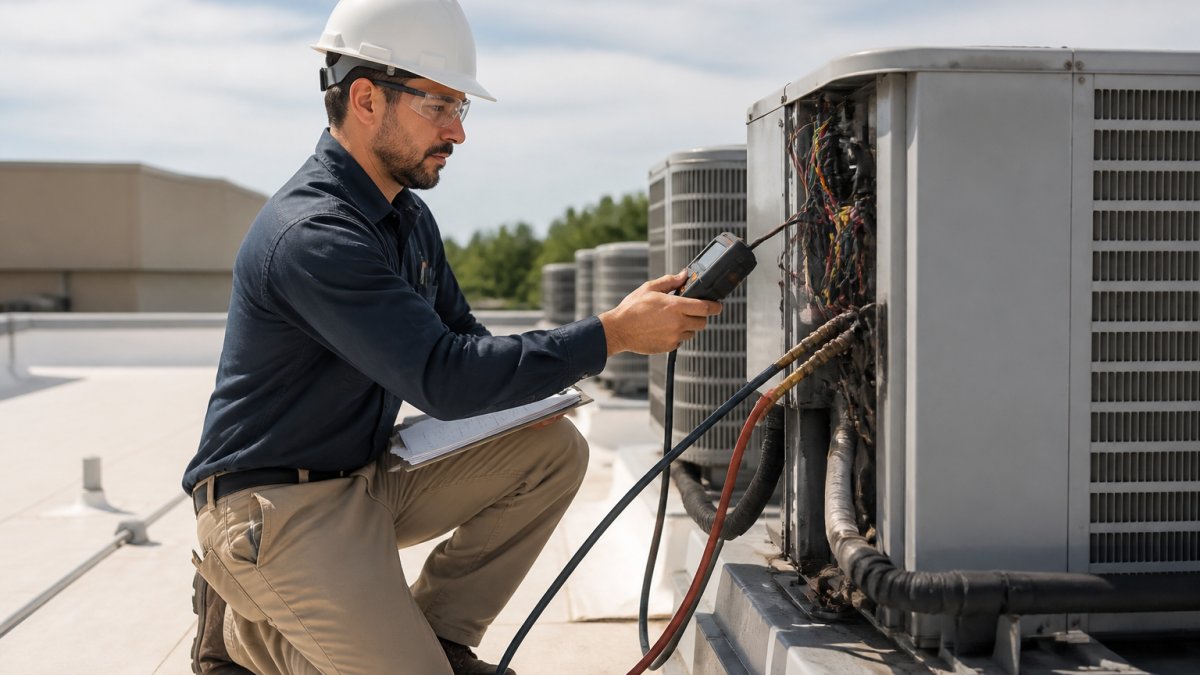
A common mistake is accepting a one-page checklist with no readings on it. Numbers matter. Amp draw, refrigerant pressures, and temperature splits tell you whether the system is drifting, and they build the repair history that justifies future decisions.
How to Set a Commercial HVAC Maintenance Schedule That Fits Your Building
The right commercial HVAC maintenance schedule depends on equipment type, building use, and climate load, not on a generic calendar. A small office with two rooftop units may need two visits a year. A restaurant with heavy grease load, a data room, or a building running 24/7 usually needs quarterly attention. Providers often build schedules around three inputs:
- Equipment age and condition at the last inspection
- Occupancy and hours of operation
- History of repeat failures on specific units
Buildings with critical cooling, such as server rooms or medical suites, warrant monthly filter checks even under a standard agreement. Match the schedule to consequence, not just to square footage.
Commercial HVAC Maintenance Contract Cost and ROI: What to Expect
Pricing for a commercial HVAC maintenance contract is not a single number, it is a bundle of cost drivers, and understanding them is how you compare bids without getting played. Most providers price on some combination of unit count, equipment type (rooftop unit, split system, boiler, chiller, mini-split), tonnage or capacity, visit frequency, access difficulty (roof hatch, ladder, locked mechanical room), and whether the agreement includes priority response and after-hours coverage.
Common Pricing Structures
| Cost Model | How It Works | Best For | Watch-Out |
|---|---|---|---|
| Flat annual fee | Fixed price for a set visit count and scope | Stable, well-maintained buildings with predictable equipment | Scope creep, confirm what happens when a visit turns into a repair |
| Per-unit pricing | Priced per piece of equipment, often tiered by tonnage | Mixed portfolios and multi-tenant buildings | Easy to compare line by line; ask for the per-unit rate card |
| Tiered agreement | Basic (inspections only), comprehensive (labor + common parts), full coverage (major components) | Buildings with critical cooling or aging equipment | The jump from basic to comprehensive is where most value sits |
| Time and materials | Pay per visit plus parts and labor | Small sites, low usage, or seasonal buildings | No priority response and no budget predictability |
| Hybrid / cap-and-coinsurance | Base fee plus a shared cost on major repairs above a threshold | Owners who want protection without full-coverage pricing | Read the cap and the exclusions carefully |
A common pattern is that a basic two-visit agreement runs a few hundred dollars per rooftop unit per year, while a comprehensive agreement with priority response and parts coverage can run two to three times that. Those are planning ranges, not quotes, the only number that matters is the one written into your scope.
The ROI Math Buyers Should Run
The return on a maintenance contract shows up in four places, and you can estimate each before you sign:
- Avoided emergency repairs. Emergency calls typically carry overtime labor, diagnostic fees, and expedited parts premiums. Count your emergency calls from the last 24 months and multiply by your average emergency invoice; a preventive agreement should cut that number materially.
- Energy savings. Dirty coils and incorrect refrigerant charge force compressors to run longer. A clean, correctly charged system uses less electricity for the same cooling, the U.S. Department of Energy's guidance on HVAC maintenance notes that regular tune-ups preserve efficiency, and efficiency losses compound over a season.
- Equipment life. Compressors and motors that run within spec last longer than ones straining against low charge and restricted airflow. Replacing a rooftop unit early is a five-figure decision; extending its life by even a year or two changes the math.
- Downtime cost. For a restaurant, retail space, or medical suite, a day without cooling is lost revenue and lost customers. Put a dollar figure on an hour of downtime for your building, that number is the real value of a same-day response commitment.
How to Compare Bids Without Getting Played
Put every proposal on the same worksheet: annual fee, visit count, task list with measurable readings, exclusions, response-time commitment, parts responsibility, reporting cadence, renewal terms, and price escalator. A low bid with vague scope usually costs more by year two because the exclusions page is where the real cost lives. A slightly higher bid with documented tasks, a firm response window, and clear parts responsibility is the better operating expense.
Service-Level Agreements: The Commercial HVAC Service Agreement Terms That Matter
A commercial HVAC service agreement is only as good as its response commitments, and most buyers never read them closely enough to compare. The visit count is the headline; the service-level agreement (SLA) is the substance. Here is what to demand in writing, and how to tell a real commitment from marketing language.
Response-Time Targets: Define Them Precisely
"Priority service" means nothing without a number. Ask for response time defined three ways:
- Acknowledgement time: how fast someone answers your call or portal ticket (often 1-2 hours during business hours).
- On-site response time: how fast a qualified technician arrives after acknowledgement. Typical tiers are 4 hours, 8 hours, next business day, or 48 hours, and the tier should be tied to equipment criticality, not a single blanket number.
- Restoration target: how fast the system is returned to service, recognizing that parts lead times can extend this. A good SLA separates diagnosis time from parts-wait time so you know which clock is running.
A four-visit plan with a two-day response window is worse than a two-visit plan with same-day priority when your building hits 95 degrees in July. Match the response tier to the consequence of failure: server rooms, medical suites, and refrigerated spaces warrant the tightest tier; general office space may not.
Get Your Free Estimate →
After-Hours Coverage and Escalation
Confirm whether nights, weekends, and holidays are included in the base fee or billed at premium rates, and what the premium is. Then ask for the escalation path: who do you call when the on-call technician does not answer, and what is the backup? A written escalation procedure, first contact, backup contact, account manager, and after-hours dispatch number, is the difference between a contract and a phone number.
Remedies: What Happens When the Provider Misses
This is the term almost no one asks about, and it is where the leverage lives. Ask for:
- Service credits or fee reductions when response targets are missed.
- Make-good provisions requiring missed preventive visits to be rescheduled at no charge.
- Termination for cause if response commitments are repeatedly missed, with a defined cure period.
Reporting and Performance Measurement
Ask what you receive and how often: service reports per visit, a quarterly performance summary, and a record of response times against targets. Track a small set of KPIs, average on-site response time, repeat failures on the same unit, preventive visit completion rate, and emergency-call volume, and review them at renewal. Those numbers are also your negotiating leverage: a provider that hits its targets earns the renewal, and one that does not has to explain why.
Renewal, Cancellation, and Price Escalators
Read the renewal clause before you sign the first term. Look for automatic renewal with a short cancellation window, annual price escalators (a fixed percentage or CPI-linked), and notice periods. Confirm who owns the service records and equipment history if you switch providers, you should, and the contract should say so. A clean handoff clause protects you at the moment you have the least leverage: the end of the relationship.
The Benefits You Can Measure: Downtime, Energy, and Equipment Life
The benefits of a commercial HVAC maintenance contract are measurable if you track the right numbers. Reduced downtime comes from catching failing contactors and worn belts during scheduled inspections instead of at 2 a.m. Energy efficiency improves when coils are clean and refrigerant charge is correct, which shows up as lower utility bills over a season. Equipment lifespan extends because compressors and motors run within spec rather than straining against dirty coils and low charge.
How to Compare Commercial HVAC Maintenance Proposals
Comparing proposals side by side is the fastest way to spot an inflated scope or a hollow one. Put every bid through the same lens:
- Does the scope list specific tasks with measurable readings?
- Are exclusions clearly stated?
- What is the response time commitment, and is it in the contract?
A low bid with vague scope usually costs more by year two. A slightly higher bid with documented tasks and a firm response window is the better operational expense. If you are switching providers, confirm the transition terms before signing, including who owns the service records.
Get Your Free Estimate from Nick's Oasis LLC
Every building has a different maintenance profile, and guessing at the scope is how owners end up overpaying for visits they do not need or missing the ones that matter. Nick's Oasis LLC provides expert HVAC services, including comprehensive installation, repair, and maintenance across central air, ductless mini-split systems, heat pumps, and furnaces, for property managers and business owners. We catch potential issues before they become major problems and maintain constant communication throughout the process.
Frequently Asked Questions
Is a commercial HVAC maintenance contract worth it?
For most commercial buildings, yes. A maintenance contract spreads tune-ups and inspections across the year, which helps catch small issues before they become costly repairs. It also supports predictable budgeting and can extend equipment lifespan. The value depends on your building's equipment age, usage, and how much downtime would cost your business. Compare the contract fee against your recent repair history and energy bills to see the potential return.
What is the typical cost of a commercial HVAC maintenance contract?
Pricing varies widely by building size, number of units, equipment type, and service frequency. Contracts are often priced per unit or as a flat annual fee, with some providers offering tiered plans. Request a free estimate from Nick's Oasis LLC tailored to your property. Ask for a breakdown of included visits, labor coverage, and parts discounts so you can compare proposals fairly.
What should be included in a commercial HVAC maintenance contract?
A strong contract lists scheduled inspections, filter changes, coil cleaning, belt and bearing checks, refrigerant level verification, and a written report after each visit. Look for priority service response times, emergency service terms, and any parts or labor discounts. Clarify exclusions such as major component replacements or refrigerant costs. The scope should match your equipment list and building usage, not a generic one-size-fits-all checklist.
How often should commercial HVAC equipment be serviced?
Most commercial systems benefit from at least two visits per year, typically in spring and fall, to prepare for cooling and heating seasons. High-use facilities or older equipment may need quarterly service. Your maintenance schedule should reflect manufacturer recommendations, equipment age, and local climate demands. A provider can help you set a frequency that balances cost with reliability.
What is usually excluded from an HVAC maintenance agreement?
Common exclusions include refrigerant, major components like compressors or heat exchangers, ductwork modifications, and repairs caused by tenant misuse or storm damage. Some contracts cap labor hours or exclude after-hours emergency calls. Read the fine print and ask for a written list of exclusions before signing. A transparent provider will explain what is not covered and offer options to add coverage.
Can a commercial HVAC maintenance contract help prevent emergency breakdowns?
Regular maintenance reduces the likelihood of unexpected failures by catching worn parts, dirty coils, and low refrigerant before they cause a breakdown. Contracts with priority service also mean faster response if something does go wrong. No contract can eliminate emergencies, but a proactive schedule and clear service-level agreement improve business continuity and reduce downtime risk.
What is the difference between an HVAC maintenance contract and a service agreement?
The terms are often used interchangeably, but a maintenance contract typically focuses on scheduled preventive tasks, while a service agreement may also define response times, priority scheduling, and repair pricing. Some providers bundle both into one document. When comparing, look at the scope of work, the service-level commitments, and the cost structure rather than the label.
How do you compare commercial HVAC maintenance proposals?
Compare proposals line by line: number of visits, tasks included, exclusions, response time commitments, parts and labor discounts, and reporting. Ask for a sample report and check whether the provider tailors the scope to your equipment. A lower annual fee may exclude key tasks or charge extra for after-hours calls. Weigh total value, not just the headline price.